The Oldest Design Department
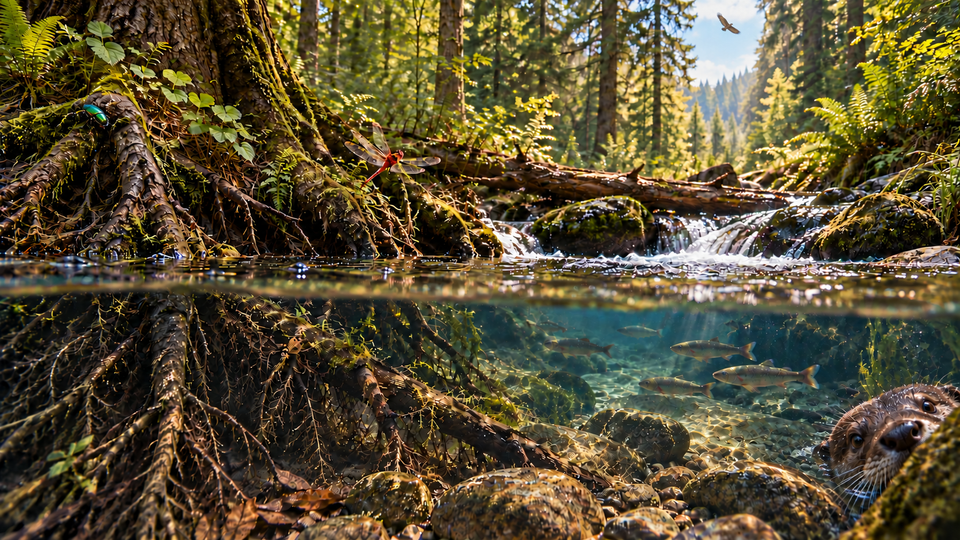
What would we design differently if Nature were our design department?
We humans are extraordinarily good at making things.
We dig up materials, refine them, combine them, heat them, press them, ship them halfway around the world, use them for a while, and eventually throw many of them away.
Nature has been making things considerably longer — a few billion years longer.
Forests. Shells. Feathers. Bones. Coral reefs. Spiderwebs. Watersheds. Soil.
And nature produces all of them without factories in the conventional sense.
That is the essential idea behind biomimicry: instead of looking at nature merely as a source of raw materials, we can look at it as a source of design knowledge.
Perhaps even as an elder.
An elder does not necessarily hand us answers. An elder has simply been here longer. Seen more. Tried more. Failed more. Adapted more.
The wisdom is there if we are willing to pay attention.
Nature has had roughly 3.8 billion years to experiment.
Biomimicry asks us to study what has endured. What works.
START WITH THE FUNCTION
Biomimicry is sometimes introduced through memorable examples.
A surface inspired by a lotus leaf.
A structure influenced by a shell.
A fastening system that borrows from burrs.
But biomimicry practitioners usually begin somewhere less visible:
What function are we trying to accomplish?
Store water.
Move efficiently.
Manage heat.
Capture nutrients.
Filter contaminants.
Protect against impact.
Build with minimal material.
Recover after disturbance.
Then comes the biological question:
How does nature do that?
That distinction matters.
The goal is not necessarily to copy an organism.
It is to understand a strategy.
A plant may store water one way. A desert beetle another. A wetland another. A watershed another.
The designer studies how living systems accomplish the function and asks whether those strategies can be translated into human design.
And frequently, when we follow the function far enough, something interesting happens.
We discover that the answer isn't an object at all.
It is a relationship.
Or a cycle.
Or feedback.
Or a network.
It is an ecosystem.
NATURE HAS PATTERNS
Beyond individual adaptations, biomimicry practitioners have identified recurring patterns found throughout living systems.
They are described through frameworks such as Nature's Unifying Patterns and Life's Principles.
These are not isolated tricks performed by particular organisms.
They are broad strategies that repeatedly appear in successful living systems over evolutionary time.
Recycle materials.
Use resources efficiently.
Respond to local conditions.
Use feedback.
Build resilience.
Adapt.
Optimize rather than maximize.
Create conditions conducive to life.
Once you see these as recurring design patterns rather than disconnected observations, biomimicry becomes something much larger than copying shapes.
It becomes a way of asking:
What does life appear to have learned about making systems work?
A FOREST ISN'T A COLLECTION OF TREES
Walk into a forest and it is easy to see trees.
Look more carefully and the forest becomes something else.
Water moves through it.
Carbon moves through it.
Nutrients move through it.
Fungi interact with roots.
Insects pollinate plants.
Animals transport seeds.
Dead organisms become nutrients for living ones.
Fallen trees become habitat, moisture reservoirs, food and eventually soil.
The interesting thing isn't any one component.
It is the relationships among them.
A forest isn't simply a lot of trees.
A watershed isn't simply a lot of water.
An ecosystem isn't simply a collection of organisms.
It is a network of exchanges.
Material moves.
Energy moves.
Information moves.
Life responds.
The parts affect one another.
Perhaps that is one of nature's most useful design lessons:
Nothing here works alone.
NATURE DOESN'T THROW ANYTHING "AWAY"
One recurring pattern in living systems is wonderfully simple:
Nature recycles materials.
But even recycling may undersell what is happening.
Nature certainly produces leftovers.
Animals excrete things.
Trees shed leaves.
Organisms die.
Branches fall.
Materials accumulate.
But there is no planetary landfill where matter finally becomes useless.
A fallen tree doesn't usually get turned into another tree.
Fungi, insects and microorganisms disassemble it. Molecules move elsewhere. Some become food. Some become soil. Some become another organism. Some return to the atmosphere.
Eventually they enter still other cycles.
One organism's output becomes another organism's opportunity.
Compare that with much of industrial design:
Extract → manufacture → sell → use → discard.
Living systems tend more toward:
Use → transform → reuse → transform again.
There is no final trash can.
There is no “away.”
Perhaps more accurately:
We humans are only beginning to understand that there never was an “away.”
Everything we have ever thrown away went somewhere.
And that realization changes the design problem.
THE PHOSPHORUS PROBLEM
Consider the element phosphorus.
It's an essential chemical that gives energy to help plants grow.
Plants need it.
Farmers need it.
Human civilization depends heavily upon it for agriculture.
But put too much phosphorus into a lake and the same useful nutrient can contribute to excessive algal growth, declining water quality and ecological damage.
So is phosphorus good?
Or bad?
Neither question is particularly useful.
The better question is:
Where is it?
In one place phosphorus is a resource.
In another, it is pollution.
The material has not changed.
Its relationship to the surrounding system has.
Carbon can be useful.
Nitrogen can be useful.
Water can be useful.
Wood can be useful.
Nutrients can be useful.
Problems often arise when something accumulates in a place, quantity or form that the surrounding system cannot effectively use.
That suggests a different design question.
Instead of asking only:
How do we get rid of it?
we can ask:
Where should it go next?
BIOMIMICRY ISN'T THE SAME AS USING NATURE
This is an important distinction.
Using a natural material is not automatically biomimicry.
Making something from wood isn't biomimicry.
Using algae isn't necessarily biomimicry.
Using shells, chitosan or biochar isn't necessarily biomimicry either.
That is closer to what is sometimes called bio-utilization: using organisms, biological materials or materials derived from them to accomplish a practical purpose.
Biomimicry asks a somewhat different question.
It asks:
What can we learn from how living systems accomplish a function?
And then:
How might we translate that strategy into design?
The distinction is useful because it gives us a more precise way to look at a company I've been involved with for years:
Aquastry.
FROM WASTE STREAM TO RESOURCE STREAM
Much of Aquastry's current work involves bio-utilization.
Shellfish processing waste contains chitin, which can be processed into chitosan, a naturally derived polymer useful in water treatment.
Woody biomass can be transformed through controlled thermal processing into biochar, a carbon-rich material that can be engineered for applications including filtration, nutrient capture and soil improvement.
Phosphorus that is troublesome in water may potentially be captured and redirected toward a place where nutrients have value again.
These are useful technologies.
But the more interesting question may be what happens when we stop looking at each one separately.
Water contamination.
Shellfish waste.
Woody biomass.
Phosphorus.
Biochar.
Agricultural soil.
Viewed conventionally, these look like unrelated products, industries and problems.
Viewed as a system, they begin to look like potential relationships.
What had been waste becomes an input.
An input helps clean water.
Something removed from the water may itself have value.
That value may be returned to soil.
Waste biomass → useful material → cleaner water → captured nutrient → healthier soil.
Now we are no longer talking only about products.
We are beginning to talk about resource cycles.
And that is where biomimicry can add another layer to the inquiry.
Not merely:
What natural material can we use?
But:
How does a healthy ecosystem move water, nutrients, energy and materials—and what might that teach us about designing the whole system?
DESIGN THE RELATIONSHIPS
This may be the most important shift in the article.
Designers are trained to design things.
A chair.
A pump.
A filter.
A building.
A water-treatment system.
But biological systems keep reminding us that the thing may be only part of the design.
A conventional engineering question might be:
How efficiently can we remove phosphorus from this water?
A biomimicry inquiry might begin with:
How does nature manage excess nutrients?
And then expand:
How do healthy wetlands retain nutrients?
How do watersheds purify water?
How are nutrients moved without becoming waste?
How are soils regenerated?
How does a lake recover from disturbance?
How do ecosystems create habitat while performing other functions?
How does feedback tell the system when conditions are changing?
How does the system remain resilient when one element is disrupted?
The boundary of the problem has expanded.
And when the boundary expands, possibilities become visible that could not be seen when we were looking only at the filter.
Suddenly the object isn't the entire design anymore.
The system is the design.
And perhaps even that does not go far enough.
The relationships are the design.
ENOUGH
One of nature's quieter lessons may be one of its most profound:
Enough.
Living systems rarely pursue maximum performance in one dimension regardless of consequences.
A tree could presumably benefit from being enormously strong.
But building a massively oversized trunk would require more material and more energy.
A bird could have heavier, stronger bones.
But additional weight would make flight more difficult.
Life constantly negotiates competing demands.
Strength—but not unnecessary weight.
Growth—but within available resources.
Competition—but also cooperation.
Consumption—but also replenishment.
Biomimicry describes one version of this principle as:
Optimize rather than maximize.
Another word for that balance might simply be:
Yes. Enough.
Enough is an important idea in relationships.
Take everything and eventually the relationship fails.
Give nothing back and eventually the relationship fails.
Ignore feedback and eventually the relationship fails.
Healthy relationships involve exchange, limits, adaptation, responsiveness and reciprocity.
Healthy ecosystems do too.
And this is where relationships and function come back together.
There is no universal amount called enough.
Enough depends upon context.
Enough water for what?
Enough strength for what?
Enough nutrient for what organism, in what soil, at what time?
Enough treatment for what downstream use?
The relationship changes what “enough” means.
Perhaps the best water-treatment technology isn't simply the one that removes the greatest possible percentage of a contaminant at any cost.
Perhaps it is the one that achieves the needed function while consuming less energy, using appropriate materials, avoiding harmful residuals, operating at the right scale and contributing positively to the larger system around it.
Not maximum.
Enough—and better connected.
LOCAL MATTERS
Nature is intensely local.
A mangrove tree doesn't order structural materials from another continent.
A caddisfly larva builds its protective case from pieces of material available in its immediate surroundings.
Living systems respond to climate, resources, water, temperature, neighboring organisms and seasonal cycles.
For designers, that raises another useful question:
What is already here?
What materials exist locally?
What waste streams?
What skills?
What biological relationships?
What existing infrastructure?
What does this place already know how to do?
A solution designed for Oregon should not automatically be assumed to be the right solution for Kenya.
A solution appropriate to a farm may not be appropriate to a lake.
Nature certainly doesn't use one design everywhere.
FROM WATER TREATMENT TO WATERSHED DESIGN
This is where biomimicry may become especially relevant to Aquastry's future work.
Aquastry is increasingly involved not only with treating water but with larger restoration problems.
Consider a lake or watershed.
A conventional treatment approach might concentrate on removing a particular contaminant.
A biomimicry approach can ask a wider set of questions:
How does a healthy lake maintain water quality?
How does a wetland retain nutrients?
How are shorelines stabilized?
How is habitat created?
How do soils rebuild biological function?
How does water move through a landscape?
How does a watershed absorb disturbance and recover?
Those functions are already being performed somewhere in nature.
The task is to study how.
Aquastry's current work on restoration efforts creates an especially interesting opportunity for this kind of thinking.
Instead of treating purification, nutrient recovery, soils, habitat and resilience as separate assignments, biomimicry can help ask how healthy watersheds accomplish them as parts of one interconnected system.
That does not mean copying a pristine lake.
It means identifying biological strategies and asking which of them can inform restoration design.
The ambition becomes larger than:
Can we clean this water?
It becomes:
Can we help the system become healthier?
MACHINE OR ECOSYSTEM?
Industrial civilization has become remarkably accomplished at building machines.
Machines are extraordinarily good at doing particular things.
But many of our biggest challenges are not really machine problems.
Water, food, soil, waste, energy, forests and communities are interconnected systems.
Solve one piece without considering the others and we can easily move a problem rather than solve it.
Clean the water but create another waste stream.
Increase agricultural production but degrade the soil.
Clear unwanted biomass but throw away its carbon and nutrients.
Remove phosphorus from water but lose a resource agriculture still needs.
Throw something “away” and discover years later that there was never an away to begin with.
Systems thinking expands the boundary.
Biomimicry asks what successful living systems inside that boundary can teach us.
And suddenly opportunities appear.
A local waste stream becomes a resource.
That resource helps perform a needed function.
Something valuable is captured.
That value becomes useful elsewhere.
The soil improves.
The water improves.
Habitat improves.
The landscape becomes more resilient.
And another cycle begins.
No single product accomplishes all of that.
The relationships do.
ANIKA'S VIEW
Aquastry has the unusual advantage of having a biomimicry specialist directly involved in its technical work.
Anika Chakravarti, a mechanical engineer and Certified Biomimicry Professional serving on Aquastry's Technical Board, works on translating functional strategies found in organisms and ecosystems into practical approaches to engineering, sustainability and restoration.
Her description of the opportunity gets to the heart of it:
“Aquastry's work demonstrates the potential of thinking beyond waste streams and treatment technologies toward resource cycles. Biomimicry adds another dimension by asking how healthy ecosystems move water, nutrients, and materials through interconnected systems, and how those biological strategies can inform more regenerative approaches to water and watershed management.”
That distinction is important.
Aquastry does not become a biomimicry company simply because it uses chitosan or biochar.
The more interesting opportunity is to apply biomimicry to the relationships among water, nutrients, soils, organisms and landscapes.
That is a much bigger design problem.
WHY IT MATTERS
We often describe nature as something to be protected.
Certainly it is.
But biomimicry proposes another relationship as well:
Nature can be consulted.
Perhaps nature should be treated less like a warehouse and more like an elder.
Not an infallible elder.
Nature can be brutal. Competitive. Unpredictable. Catastrophic.
But it is an elder that has been experimenting with structure, chemistry, energy, information, adaptation and relationships for roughly 3.8 billion years.
That is a considerable body of experience.
Some of its most useful lessons may not be spectacular creatures or ingenious shapes.
They may be quieter patterns:
Start with function.
Look for strategies that have endured.
Pay attention to feedback.
Work with local conditions.
Use what is available.
Turn outputs into inputs.
Build resilience.
Optimize rather than maximize.
Know when there is enough.
Remember that there is no “away.”
And look beyond the object to the system around it.
Aquastry began with the practical business of cleaning water.
But follow the work outward—from chitosan and waste shells to woody biomass and engineered biochar, from phosphorus capture to soil, lakes and watersheds—and the design question becomes larger.
Not simply:
How do we treat this?
But:
What relationships do we need to restore?
Maybe the next generation of useful things won't really be things at all.
Maybe they will be better relationships between the things we already have.
Nature has been working that way for a very long time.
Perhaps it's time we gave the elder some respect.
SOURCES & FURTHER EXPLORATION
BIOMIMICRY
Biomimicry 3.8 — Life's Principles / DesignLens
A framework for understanding recurring strategies found across successful living systems and applying those strategies to human design.
Biomimicry Institute — Biomimicry Toolbox
Introductions to biomimicry, systems thinking and biological design strategies.
AskNature — Biomimicry Institute
A resource organized around biological functions and strategies—for example, how organisms and ecosystems manage water, materials, energy and other design challenges.
AQUASTRY & RELATED WORK
Aquastry
A company that does water treatment, resource recovery, and soil amendments toward a circular ecosystem using waste chitin (crab and shrimp shells) and waste woody biomass to create proprietary chitosan polymer and patented, functionalized, engineered biochar for highly-scalable water-resilience work.
Anika Chakravarti — Certified Biomimicry Professional
Mechanical engineer and member of Aquastry's Technical Board whose work focuses on translating functional strategies found in organisms and ecosystems into practical approaches to engineering, sustainability, innovation and ecosystem restoration.
RELATED RESEARCH
Mainali et al., Biomass and Bioenergy, 2024
Research involving engineered biochar and Aquastry-supplied chitosan for phosphorus adsorption, including examination of potential agricultural reuse.
Washington State University research on phosphorus-removal media
Research evaluating biochars, chitosan and related treatment materials in phosphorus adsorption and water-treatment applications.
Member discussion