The Fourth Market for Solar
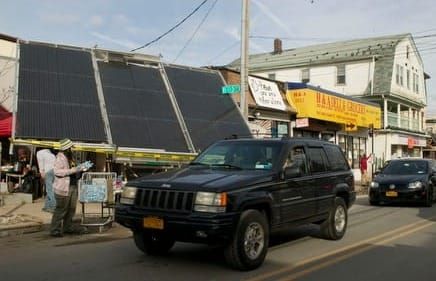
What happens to a useful idea when the world isn't quite ready for it?
Years ago, I was working for a company that made an unusual investment.
It bought a mobile solar generator.
I hadn't invented the machine or the idea behind it. But I embraced it.
The company created a subsidiary, Renewables West, to promote and sell mobile solar generators, and I was given an additional job: General Manager.
That additional assignment eventually occupied a remarkable part of my life.
For the better part of nine years, I hauled mobile solar generators around California. Trade shows. Demonstrations. Meetings. Community events. Emergency-response gatherings. Anywhere I thought someone might look at one and recognize what had begun to seem obvious to me:
Why are we burning diesel fuel to make temporary electricity when we can bring the power plant with us?
I wasn't suggesting that solar could replace every diesel generator, everywhere, under every circumstance.
I was suggesting that there was another enormous market for solar hiding in plain sight.
In 2014, I wrote about it and gave it a name:
The Fourth Market for Solar
THREE MARKETS — AND ONE MISSING
At the time, solar energy was generally discussed in three familiar categories.
There was utility-scale solar: enormous installations feeding power into the electric grid.
There was commercial solar: panels on factories, warehouses, offices and other businesses.
And there was residential solar: increasingly familiar photovoltaic panels appearing on people's roofs.
But there was another extraordinarily distributed power system all around us.
Portable generators.
Diesel and gasoline generators powered construction sites, outdoor events, military operations, farms, disaster zones, communications equipment, hospitals, emergency centers and countless places where electricity needed to go somewhere the grid didn't.
In my original 2014 paper, I described fossil-fueled generators as perhaps the most widely distributed power-generation system of all.
That suggested a fairly simple question:
What if solar could become mobile, too?
Not solar panels permanently attached to a building.
A power plant you could tow behind a truck.
Solar panels. Batteries. Inverters. Controls. Outlets. Sometimes a backup generator. Packaged together into a rugged unit that could be driven wherever electricity was needed.
Park it.
Deploy it.
Turn it on.
THE FUEL IS ALREADY THERE
Diesel generators have one extraordinary advantage.
They can produce a lot of electricity from a relatively small machine, almost immediately.
That's difficult to beat.
But they come with an equally important disadvantage:
They continually need fuel.
The generator may be sitting exactly where you need electricity, while the energy needed to keep it running may be hundreds or thousands of miles away — being extracted, refined, transported, stored, purchased and eventually delivered to the machine.
During normal operations, that's an expense.
During a disaster, it can become a vulnerability.
Solar changes that equation.
Its fuel arrives on its own.
Every morning the Sun comes up.
Batteries can provide electricity instantly and quietly. Solar can replenish them. A hybrid system can retain a conventional generator for unusually high loads, extended bad weather or other contingencies while dramatically reducing the amount of fuel required.
That gradually changed the way I thought about these machines.
We weren't simply looking at an alternative way to generate electricity.
We were looking at a different way to deliver energy.
And that distinction becomes very important when everything else has gone wrong.
KATRINA CHANGED THE QUESTION
During several of those years, I became deeply involved in the emergency-response world — from local and regional organizations to national meetings and conversations involving FEMA and other federal agencies.
Hurricane Katrina kept coming up.
Katrina exposed a weakness in emergency power that I had never fully appreciated.
A hospital might have a diesel generator.
It might even have several.
But having a generator is not the same thing as having emergency power.
Floodwater can disable the generator itself, its fuel tanks, pumping equipment, transfer switches, electrical panels and other pieces required to make emergency power actually reach the building. FEMA later documented precisely those kinds of vulnerabilities and cited Katrina hospital failures in which generators remained functional but flooded electrical equipment prevented the emergency system from supplying critical loads.
Fuel creates another problem.
A diesel generator doesn't merely require diesel.
It requires usable diesel, in the right place, at the right time.
During Katrina, I heard stories of submerged equipment, contaminated fuel and hospitals whose backup-power systems failed when they were needed most.
Then came the logistics.
Generators, fuel and other supplies had to be moved into devastated areas. Roads might be flooded or impassable. Airfields, staging areas, military transports and helicopters became part of the emergency supply chain.
FEMA later reported that federal agencies and their partners installed 310 temporary generators during the Katrina response.
I remember hearing about generators and critical supplies being moved by military aircraft — C-130s and C-17s into the region, sometimes followed by helicopter movement for the last difficult miles — and wondering:
What did that gallon of diesel really cost by the time it reached the place that desperately needed it?
Not its price at the pump.
Its delivered cost.
Aircraft.
Flight crews.
Fuel for the aircraft carrying the generator or carrying the fuel.
Ground personnel.
Staging.
Helicopters.
Coordination.
Time.
For perspective, the Air Force's fiscal-year 2005 figures placed a C-17 training flying hour at about $9,200. That isn't nearly the all-in cost of a Katrina mission, and it certainly doesn't tell us what any specific generator delivery cost.
But it illustrates the point.
A few hours of heavy-aircraft operation alone could represent tens of thousands of dollars — before adding another aircraft, ground support, emergency logistics or the generator itself.
That caused me to look at the comparison differently.
The question wasn't merely:
Which generator costs more?
The question was:
Which energy-delivery system makes more sense when the normal supply chain has collapsed?
One requires that fuel continually reach the machine.
The other arrives with part of its future fuel supply built into its design.
The Sun will come tomorrow whether the fuel truck does or not.
THEN CAME SANDY
In 2012, Superstorm Sandy gave us a chance to see the idea work outside a trade show.
One of the mobile solar generators we were involved with, a hybrid unit called Mojave-3, went east for disaster response.
It operated in the Rockaways in New York and also supported relief activity in New Jersey.
A contemporary account from the Local Clean Energy Alliance reported that the system provided electricity for a hot-food kitchen, a medical clinic, a ranger station and a charging station for cell phones, flashlights and other critical equipment.
The unit incorporated solar, substantial battery storage and a backup diesel generator.
In my 2014 account, I noted that it operated around the clock for about three weeks during winter weather while consuming only about half a tank of diesel. Even if the fuel had disappeared entirely, the solar-and-battery system would still have remained capable of providing power.
That experience reinforced something I'd begun to suspect after Katrina.
The generator wasn't really the whole problem.
The problem was getting energy to where people needed it.
WHAT ELSE COULD WE PUT ON WHEELS?
Once we started looking at these machines as mobile infrastructure instead of simply mobile solar generators, all sorts of possibilities emerged.
We discussed many configurations.
One was essentially a mobile energy hub.
A larger solar-and-battery unit could carry or charge perhaps six to ten smaller battery systems. Those batteries could then be trucked or towed to clinics, communications sites, emergency command posts, shelters or other locations nearby.
When depleted, they could return to the central unit and be swapped or recharged.
In effect, electricity itself became distributable.
Generate it.
Store it.
Move it.
Use it.
Bring the battery back.
Charge it again.
Another concept combined mobile electricity with another fundamental post-disaster need:
Water.
We discussed pairing mobile solar generators with an adjacent trailer containing a small desalination or water-purification system.
After a disaster, communities often need both safe water and electricity.
Traditionally, we transport enormous quantities of both—or transport the fuel required to produce them.
Why not instead transport some of the capacity to produce them locally?
MOBILE ENERGY FOR MORE THAN EMERGENCIES
Those ideas eventually contributed to a separate initiative I started called Project ME4.
The letters stood for:
Mobile Energy for Emergency, Education and Enterprise.
The important word wasn't emergency.
It was and.
Why should expensive emergency equipment spend most of its life sitting in a warehouse waiting for something terrible to happen?
A mobile renewable-energy platform could spend ordinary days doing ordinary useful work.
Put one at a school.
Use it to teach students about electricity and renewable energy.
Power equipment from it.
Use it at community events.
Take it to remote projects.
Put another at a fire station, clinic or community center.
Then, when the grid goes down or disaster strikes, those same machines become emergency infrastructure.
They're already distributed.
Already maintained.
Already familiar to local users.
Already producing something of value.
And they're already where people are.
In December 2012, while Mojave-3 was assisting Sandy recovery, the Local Clean Energy Alliance described Project ME4 as an organization devoted to exactly that idea: mobile energy for emergency, education and enterprise.
I still like the principle behind it:
Don't warehouse resilience. Put it to work.
AN IDEA LOOKING FOR ITS MARKET
All of this sounds fairly reasonable to me today.
It sounded reasonable to me then, too.
That didn't mean people bought them.
We hauled the equipment around.
We demonstrated it.
People liked it.
They appreciated clean power.
They especially appreciated quiet power when a diesel generator was rumbling nearby.
They understood the attraction of eliminating exhaust and reducing fuel consumption.
But liking an idea and changing purchasing behavior are two very different things.
Diesel generators had an enormous ecosystem built around them.
Rental companies knew how to rent them.
Procurement departments knew how to buy them.
Mechanics knew how to maintain them.
Construction crews knew what they could plug into one.
Emergency managers knew how to request them.
Everyone knew what budget category they belonged in.
Diesel wasn't simply a technology.
It was an established habit.
Mobile solar didn't fit quite so neatly.
Was it a generator?
A solar installation?
A battery bank?
Emergency equipment?
A trailer?
A capital purchase?
Something you rented?
Even the language hadn't settled.
Today we might call variations of these systems mobile microgrids, mobile energy storage systems, solar-plus-storage trailers or mobile BESS — battery energy storage systems.
Back then, even the vocabulary was looking for somewhere to land.
THEN THE WORLD STARTED CATCHING UP
A great deal has changed since I stopped towing these machines around.
Solar modules became less expensive and more capable.
Battery technology improved dramatically.
Lithium-based systems can store useful amounts of electricity in far less space and weight than many of the battery banks we worked with.
Power electronics improved.
Remote monitoring became ordinary.
Electric vehicles helped create an enormous battery, charging and energy-management industry.
Microgrids became an established category.
And resilience moved from the margins of energy planning toward the center.
Wildfires, hurricanes, extreme weather, Public Safety Power Shutoffs and increasingly stressed electrical systems have made backup electricity much harder to treat as an afterthought.
The idea I once called the Fourth Market didn't emerge as one tidy industry bearing that name.
Instead, pieces of it began appearing everywhere.
And then, in July 2026, I encountered something that made me smile.
The California Energy Commission published the results of a project it had funded to design, build, field-test and deploy a mobile renewable backup-power system.
It's called the Intelli-trailer.
It's a trailer.
It has solar panels.
It has batteries.
It's intended for communities affected by wildfires, power shutoffs, grid outages and rural energy insecurity.
The Commission reports that testing demonstrated it could replace small diesel generators across a broad range of emergency and non-emergency applications, while reducing operating costs, emissions, noise and safety risks.
Twelve years earlier, my Fourth Market paper argued for mobile solar generators positioned at schools and first-responder stations, performing useful daily work while remaining available for disaster response.
Different machine.
Different organization.
Different decade.
Very familiar idea.
WAS IT BEFORE ITS TIME?
People like to say an unsuccessful idea was “ahead of its time.”
Sometimes that's probably just a comforting explanation.
Bad ideas can be early, too.
But I've come to believe there is another category.
An idea can work technically while the system around the idea isn't ready for it yet.
The components may still cost too much.
The supporting technology may need another generation.
Regulations may not recognize the category.
Customers may not know whose budget it belongs in.
The people who benefit from it may not be the people who purchase it.
The established alternative may have decades of infrastructure behind it.
Or everyone may simply be waiting for someone else to go first.
That's important for inventors, designers, entrepreneurs—and anyone trying to bring a useful thing into the world.
We naturally ask:
Does it work?
But that isn't enough.
We also need to ask:
What else has to become true before this works as a market?
And perhaps the harder question:
Can you survive long enough for those things to become true?
I spent the better part of nine years trying to help this particular idea find its place.
It mostly didn't.
At least not then.
THE FOURTH MARKET STILL EXISTS
I don't haul solar generators around anymore.
But I haven't lost interest in what they represented.
Millions of engines are still scattered around the world whose purpose is to sit somewhere and convert fossil fuel into temporary electricity.
Some are indispensable.
Many probably aren't.
Every application we can move to cleaner, quieter, locally rechargeable power eliminates some combination of fuel transportation, exhaust, noise, maintenance and vulnerability.
And today's technology makes possible things we could only sketch out years ago.
Mobile battery systems.
Solar-plus-storage trailers.
Mobile microgrids.
Battery-swapping hubs.
Vehicle-to-grid systems.
Mobile power for communications, medicine, refrigeration and water treatment.
Community systems that do useful work every day and transform into resilience infrastructure when something goes wrong.
Perhaps that's the part of the Fourth Market idea I still find most compelling.
Not solar panels.
Not trailers.
Not even generators.
It's this:
Energy doesn't necessarily have to be delivered as fuel.
It can be generated locally.
Stored.
Moved.
Shared.
Recharged.
And positioned before anyone desperately needs it.
Maybe the Fourth Market for Solar was never really a fourth solar market.
Maybe we were catching an early glimpse of something larger:
Portable, distributable resilience.
WHY IT MATTERS
Useful ideas don't arrive in an empty world.
They encounter existing infrastructure, habits, economics, regulations, language and organizations that were built around whatever came before them.
Sometimes the invention isn't the part that's missing.
The world around it is.
Mobile solar taught me something I've carried into almost every project since:
Being able to build the future and being able to sell the future are two very different problems.
And sometimes an idea doesn't fail.
Sometimes the world is still assembling the pieces it needs to say yes.
Member discussion